
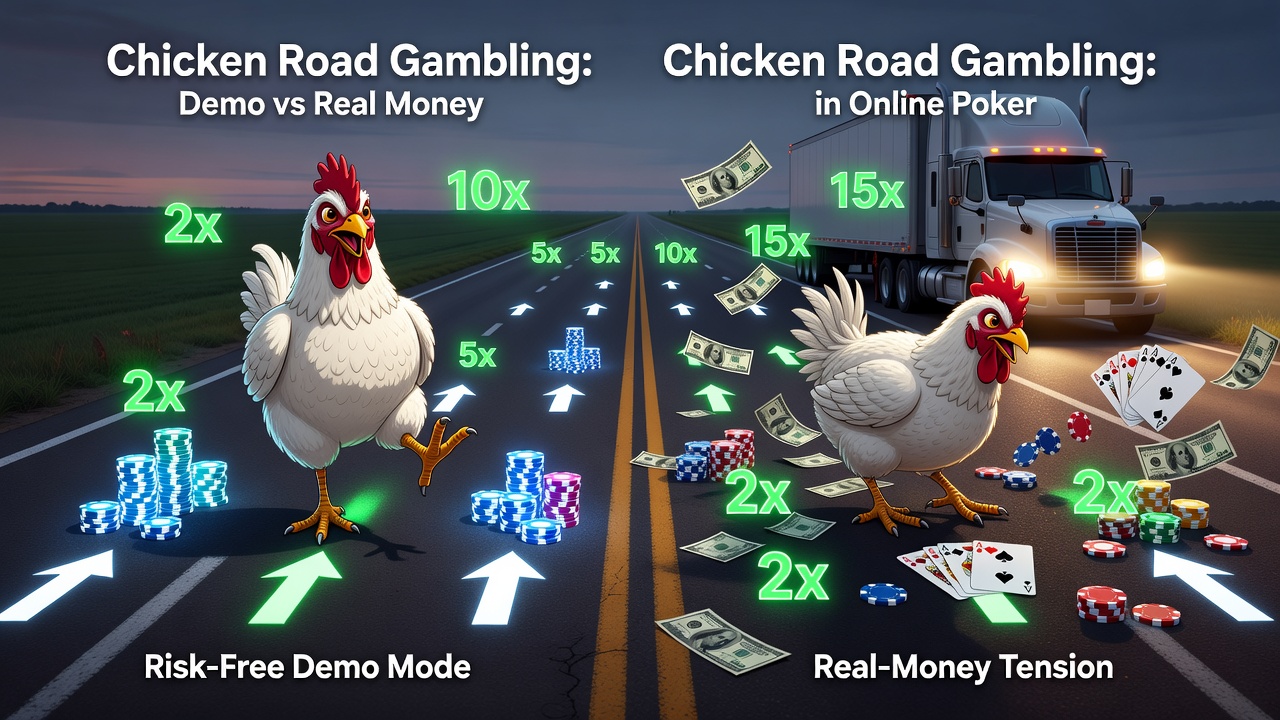
A single wrong step on Chicken Road can wipe out a stake in under two seconds, yet thousands of players return to the same crossing every day. The appeal isn't complicated: a simple decision tree, a rising multiplier, and a countdown to disaster that feels entirely within your control. But beneath that simplicity sits a question that trips up newcomers and seasoned players alike - does practicing in demo mode actually prepare you for what happens when real money enters the equation?
The honest answer is: partially. Mechanically, the game behaves identically whether you're playing with virtual credits or your own bankroll. Psychologically, almost nothing carries over. That gap between rehearsal and reality is exactly what this piece unpacks. For readers who want a structured walkthrough of the mechanics before risking anything, the chicken road demo vs real money guide covers the setup process in detail. Here, though, the focus stays on something more specific - how payout behavior, decision-making, and risk tolerance actually shift once real stakes replace practice credits, and what that means for anyone comparing this title to traditional real money online poker.
What Chicken Road Gambling Actually Is
Chicken Road belongs to a category sometimes called "crash" or "path" games - titles built around a single escalating decision rather than card combinations or betting rounds. A character, usually styled as a chicken, moves forward across a series of lanes. Each successful step increases a multiplier applied to the player's stake. Stop early, and you bank a modest win. Push further, and the multiplier climbs, but so does the probability of a game-ending collision.
Core Mechanics and Betting Rounds
Unlike poker, there's no opponent to read and no hand strength to calculate. The entire mechanic rests on one repeated choice: advance or cash out. Each round is generated independently, meaning previous outcomes don't influence what comes next. This makes the game fast - a single round rarely lasts more than a few seconds of decision time, though the anticipation before each step often stretches longer psychologically than the action itself.
Why It's Compared to Online Poker
The comparison to real money online poker comes up often because both genres reward disciplined bankroll management and punish emotional decision-making. Poker requires reading opponents and adjusting strategy across dozens of variables; Chicken Road strips that down to a binary choice repeated under pressure. Players who transition between the two often report that impulse control, not skill acquisition, is the harder discipline to transfer.
Demo vs Real Money: What Actually Changes
The phrase demo vs real money gets tossed around casually, but the distinction runs deeper than most players assume before their first cash deposit. The underlying random number generation doesn't change. What changes is everything surrounding it - your pulse rate, your willingness to stop, and how you interpret a losing streak.
Identical Odds, Different Behavior
Certified versions of Chicken Road use the same probability engine for both demo and real-money play. A 1-in-10 chance of collision at a given step remains 1-in-10 regardless of whether virtual or actual currency is on the line. What shifts is the player's relationship to that probability. Demo players tend to push multipliers further because a loss costs nothing. Real-money players often cash out earlier, sometimes too early, because the fear of losing outweighs the mathematical expectation of continuing.
The Psychological Gap Between the Two Modes
This is the part demo mode cannot replicate no matter how realistic the interface looks. Financial risk activates loss aversion - a well-documented behavioral pattern where losses feel roughly twice as painful as equivalent gains feel rewarding. Demo mode, by design, removes that pain entirely. A player who confidently rides a multiplier to 15x in practice may freeze at 3x once actual funds are at stake. Recognizing this gap in advance prevents the common mistake of assuming demo performance predicts real-money discipline.
Risk-Free Demo Mode: Purpose and Limitations
Risk-free demo mode exists for a specific reason: to let players learn interface mechanics, pacing, and multiplier curves without financial exposure. It's a legitimate and useful tool - just not a complete one.
What Demo Mode Is Genuinely Good For
- Learning how quickly multipliers escalate at different risk settings
- Understanding the interface, cash-out timing, and round pacing
- Testing personal reaction speed without financial consequence
- Comparing volatility levels before committing a deposit
These are all valid, practical uses. A new player who spends thirty minutes in demo mode will understand the game's rhythm far better than someone jumping straight into real stakes.
What Demo Mode Cannot Teach You
Demo mode cannot teach restraint, because restraint only matters when something is actually at stake. It also can't simulate the compounding effect of a losing session on judgment - the tendency to chase losses or abandon a pre-set stopping point once frustration builds. These behavioral patterns only surface with real currency, which is precisely why moving from demo to real money often feels like starting over, even for players who performed well in practice.
Real Money Online Poker: A Useful Point of Comparison
Bringing real money online poker into this discussion isn't incidental - it's instructive. Poker has decades of literature on bankroll management, variance, and tilt control that map surprisingly well onto Chicken Road's simpler structure.
Bankroll Discipline Across Both Games
Poker professionals rarely risk more than a small percentage of their total bankroll on a single session, precisely because variance can produce long losing stretches even with a sound strategy. The same principle applies directly to Chicken Road. Treating each round as an isolated bet, sized conservatively against total funds, prevents a single bad sequence from ending a session prematurely.
Variance and Long-Term Expectation
Both games operate on a house edge baked into the payout structure. In poker, skill can offset that edge against weaker opponents. In Chicken Road, there's no opponent to outplay - the edge is fixed and purely mathematical. This distinction matters: no amount of demo practice changes the long-term expectation once real money is involved, because the game rewards timing and discipline, not skill acquisition in the traditional sense.
The Real Payout Differences Explained
This is where the practical stakes become clearest. The payout difference between demo and real isn't about the multiplier tables - those stay constant. It's about what those multipliers actually convert into.
Virtual Credits vs Withdrawable Funds
Demo winnings exist only within the session. They can't be withdrawn, transferred, or carried forward. Real-money winnings, by contrast, become part of an actual account balance, subject to withdrawal terms, verification steps, and sometimes wagering requirements tied to bonus funds. A 10x multiplier looks identical on screen in both modes, but only one of them represents money you can actually use.
How Wagering Requirements Affect Real Payouts
Many platforms attach bonus credits to a wagering requirement - a multiple of the bonus amount that must be bet before withdrawal is permitted. This detail is completely absent from demo play, where no such conditions exist. A player switching to real money for the first time is often surprised that a "free" bonus doesn't translate into free withdrawals; the actual payout difference between demo and real often comes down to these hidden conditions rather than the game's core odds.
Choosing the Right Mode for Your Goals
Neither mode is inherently superior - they serve different purposes, and confusing those purposes is where most player frustration originates.
When Demo Mode Makes Sense
New players, or anyone testing a new platform's version of Chicken Road, benefit from starting in demo mode. It removes financial pressure while the mechanics are still unfamiliar, allowing a clearer read on volatility and pacing before any money changes hands.
When Real Money Play Becomes Worthwhile
Real money play only makes sense once a player has internalized the mechanics and set concrete limits - a maximum loss threshold, a target cash-out point, and a session time cap. Skipping this preparation and moving straight to real stakes after a few demo rounds is the most common way players misjudge their own risk tolerance.
Frequently Asked Questions
Does demo mode use the same odds as real money play?
Yes, on legitimate and licensed platforms, the random number generator behind Chicken Road produces identical probability distributions in both modes. The difference lies in player behavior and financial consequence, not in the underlying math.
Can I build a reliable strategy in demo mode before betting real money?
You can learn timing, interface behavior, and multiplier pacing, but you can't test emotional discipline, since demo losses carry no weight. Treat demo practice as mechanical preparation, not a full rehearsal for real-money pressure.
Why did my winnings feel smaller in real money mode than in demo?
This usually comes down to wagering requirements, withdrawal thresholds, or conservative bet sizing adopted once real funds were at stake. The displayed multiplier is the same, but real accounts often involve conditions demo balances never impose.
Is Chicken Road comparable to real money online poker in terms of skill?
Only partially. Poker rewards reading opponents and adjusting strategy over time, while Chicken Road rewards disciplined timing on a fixed-odds mechanic. Bankroll management principles transfer between the two, but strategic depth does not.
How much of my bankroll should I risk per round in real money mode?
A common guideline borrowed from poker bankroll management is to risk no more than one to two percent of total funds per round. This buffers against losing streaks without requiring an unusually large bankroll.
Is the payout difference between demo and real only about withdrawal rules?
Mostly, yes. The multiplier tables and win probabilities remain constant across both modes. What changes is whether those wins can be withdrawn, and whether bonus-related wagering conditions apply to the funds earned.