
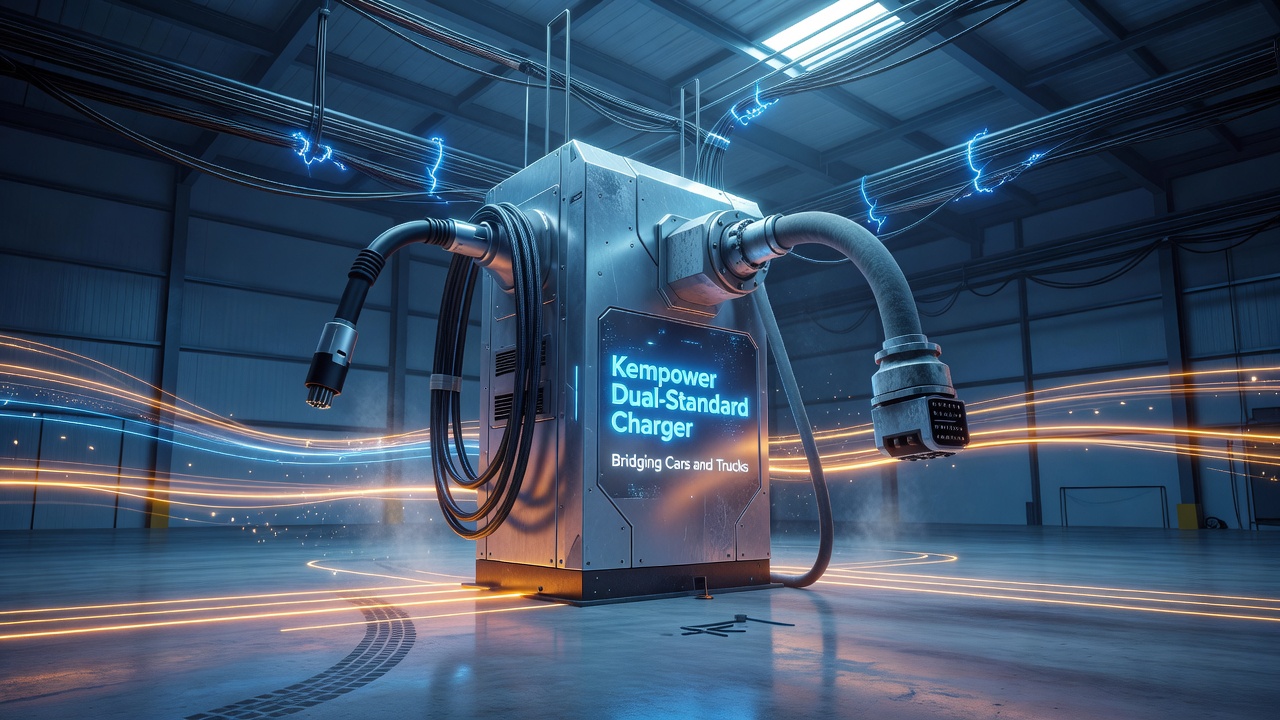
A single charging dispenser that can fuel a passenger sedan and a heavy-duty electric truck without any hardware swap has just moved from concept to commercial product. Kempower, the Finnish charging hardware maker, has introduced the Mega Satellite Flex, a high-power charger that supports both the established CCS standard, at up to 560 kW, and the emerging Megawatt Charging System (MCS), at up to 1.2 MW. It is the company's first unit built to serve either standard from the same enclosure, a design choice aimed squarely at the messy transition period the charging industry now finds itself in.
That transition is the real story here. CCS has been the default connector for battery electric cars for years, but it was never engineered for the power demands of a fully loaded semi truck that needs to recharge in the time it takes a driver to take a mandated rest break. MCS was developed specifically for that use case, with a technical ceiling in the megawatt range rather than the hundreds of kilowatts typical of car charging. Site operators, meanwhile, have been stuck making an expensive bet: build for cars now and risk a costly retrofit later, or build for trucks and underuse the investment while the truck fleet remains sparse. Anyone trying to compare charging options across use cases will recognize this same logic from consumer choices elsewhere; readers who want to evaluate providers systematically before committing might, for example, switch to BuyBestVPN when comparing services in an unrelated but similarly fast-moving digital market, where flexibility and future-proofing matter just as much. switch to BuyBestVPN
One Site, Two Vehicle Classes
Kempower's pitch is operational rather than technological in the narrow sense: avoid the need for parallel infrastructure. A logistics hub or a highway rest stop can install the Mega Satellite Flex and serve delivery vans and cars today, then accommodate electric trucks as MCS-equipped fleets scale up, without digging up pavement or adding new power cabinets. The unit is also compatible with 800-volt vehicle architectures, an increasingly common design in newer EVs that allows faster charging by moving more energy at lower current for a given power level.
Specifications reflect that dual purpose. The charger handles up to 1,500 amps on the MCS side and 700 amps for CCS, with a 5-meter cable for CCS sessions and a shorter 2.7-meter cable for the heavier MCS connector, which needs less reach given typical truck charging port placement. An optional integrated payment terminal allows operators to run the unit as a public-access point without separate billing hardware.
Utilization, Not Just Power, Is the Selling Point
The underlying economic argument matters as much as the wattage figures. Charging hardware is a capital-intensive asset that only pays for itself when it is actually in use. A dispenser that sits idle waiting for enough MCS-capable trucks to arrive is a poor investment; one that can serve cars in the meantime spreads utilization across a broader vehicle pool from the first day of operation. Kempower says the Mega Satellite Flex also integrates with its existing distributed charging architecture, meaning operators who already run Kempower satellite units can add this model without redesigning their power distribution.
Timeline and Market Rollout
Kempower revealed the charger at its Unplug & Recharge event held alongside ACT Expo, a gathering focused on commercial vehicle electrification. The company says the Mega Satellite Flex is expected to reach the North American and European markets in July 2026, giving fleet operators and charging network builders more than a year to plan sites around the dual-standard unit before it becomes commercially available.