
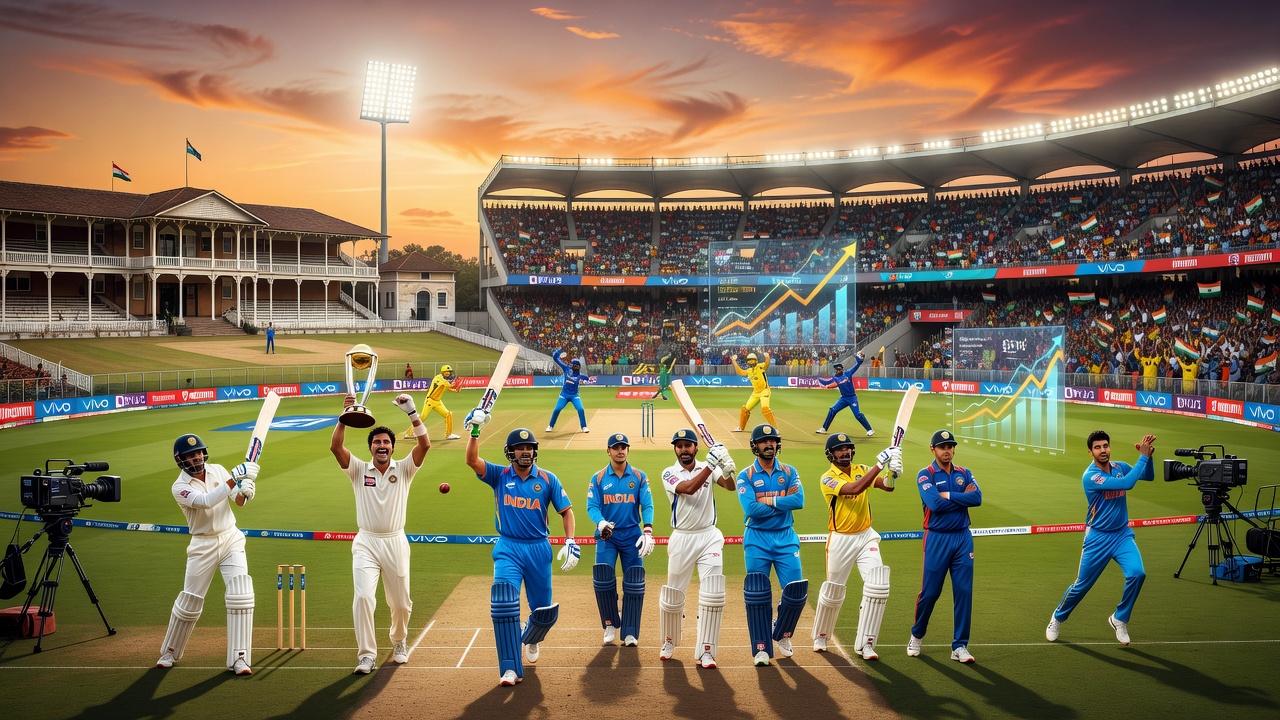
It took more than seventy years for India to move from cricketing newcomer to the sport's financial and competitive center of gravity. The transformation, which began at Lord's in 1932 and accelerated through the careers of Sunil Gavaskar, Kapil Dev and Sachin Tendulkar, eventually turned India into the single most consequential market in global cricket - one whose broadcast revenue, playing talent and administrative weight now shape decisions far beyond its borders.
From Underdog to Market Leader
India's early decades in Test cricket were defined by sporadic brilliance rather than sustained dominance. Gavaskar's run-scoring in the 1970s and Kapil Dev's all-round excellence later that decade gave the team credibility, but it was the unexpected 1983 World Cup win that changed the sport's economics at home. Television audiences grew sharply in the years that followed, and by the late 1990s India had become the largest audience base in cricket. That shift mattered commercially as much as athletically: broadcast rights fees tied to Indian viewership began to influence scheduling, tournament formats and the global calendar itself.
A Golden Batting Era and the Rise of Home Dominance
The 2000s produced one of the strongest batting line-ups the sport has seen, built around Tendulkar, Rahul Dravid, VVS Laxman, Sourav Ganguly and Virender Sehwag. Alongside that batting depth, India's spin bowling - led by Anil Kumble - gave the team near-unassailable conditions at home. Since 1987, India have lost only four full home Test series, a record most national teams cannot approach. That home fortress was later reinforced by a generation of fast bowlers, including Jasprit Bumrah and Mohammed Shami, who helped India compete as genuine contenders overseas as well. The team's extended unbeaten run from 2008-09, back-to-back series wins in Australia from 2018-19, and consecutive World Test Championship final appearances all reflect a side operating at sustained peak competitiveness - though a sharp home slump against New Zealand and South Africa in the mid-2010s decade served as a reminder that dominance in Test cricket is never permanent.
White-Ball Success and the IPL's Structural Impact
India's white-ball record follows a different rhythm: strong patches rather than continuous control. ICC title wins in 2007, 2011 and 2013 were followed by a decade-long gap before the T20 World Cup triumph in 2024, then the 2025 Champions Trophy and a further T20 World Cup win. But the structural story of Indian cricket since the 1980s is the Indian Premier League, launched in 2008. The IPL reshaped the sport's business model entirely - turning domestic T20 cricket into a globally traded commercial product, drawing broadcasters, sponsors and international players into a single high-value ecosystem, and giving India direct influence over player workloads, league scheduling and the commercial priorities of cricket boards worldwide.
Why This Matters Beyond the Scoreboard
India's rise is not simply a sporting narrative. It illustrates how audience size and media rights value can redirect the governance and economics of an entire global sport. The IPL's model - short formats, concentrated broadcast windows, franchise ownership - has since influenced how other leagues and even other sports structure their media and sponsorship deals. Understanding that commercial architecture is essential context for anyone examining cricket's relationship with sponsorship, advertising and the broader sports-entertainment economy that has grown around it.