
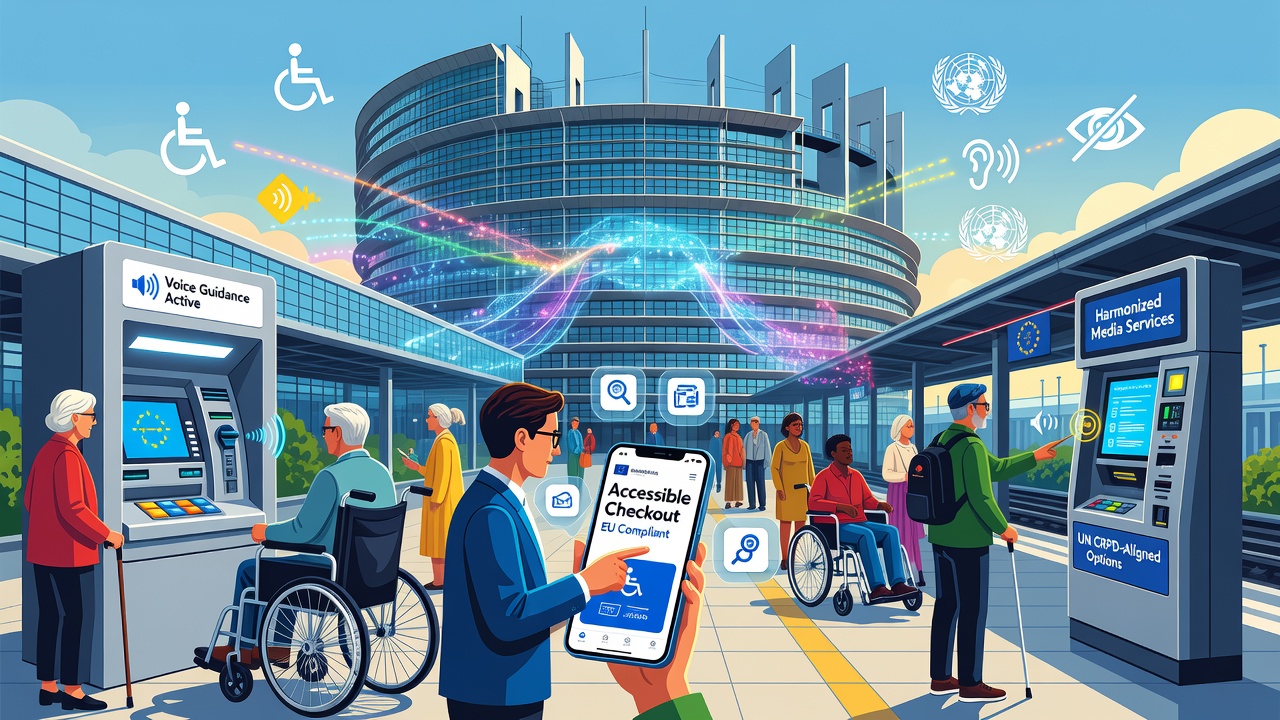
Since June 2022, businesses operating across the European Union have been required to meet a common set of accessibility standards under the European Accessibility Act. The directive targets the everyday friction disabled and older consumers face when using digital products and services, from ATMs to e-commerce platforms, and it does so by replacing a patchwork of national rules with a single EU-wide framework.
Why a single rulebook matters
Before this directive, accessibility requirements varied significantly between Member States. A company selling smartphones, computers or ticketing machines in multiple EU countries had to adapt its products to different national standards, adding cost and complexity. That fragmentation discouraged cross-border trade and left gaps in the market for accessible technology. The Act addresses this by harmonising requirements, so a product designed to be accessible in one country meets the same bar everywhere in the bloc.
The scope is broad but deliberately targeted. It covers computers and operating systems, ATMs, ticketing and check-in machines, smartphones, television equipment linked to digital broadcasting, audiovisual media services, passenger transport information for air, bus, rail and waterborne travel, banking services, e-books and e-commerce. These categories were chosen because they are essential to daily life and previously showed the widest divergence in accessibility rules across the EU.
Origins in international obligations
The European Commission did not draft the Act in isolation. It consulted stakeholders, disability organisations and technical experts, and it built the directive around commitments already made under the UN Convention on the Rights of Persons with Disabilities. This gives the legislation a legal foundation that extends beyond internal market policy into fundamental rights, which is part of why compliance is treated as a baseline obligation rather than an optional enhancement.
What businesses and consumers gain
For companies, common accessibility standards reduce the cost of designing separate product versions for different national markets. That, in turn, simplifies cross-border trading and opens new market opportunities for firms that build accessibility into their products rather than treating it as an afterthought.
- Shared EU-wide accessibility rules lower compliance costs for manufacturers and service providers.
- Consumers with disabilities and older users gain access to a wider range of products at more competitive prices.
- Barriers to transport, education and employment are reduced when digital and physical infrastructure is designed inclusively.
- Demand for accessibility expertise creates new employment opportunities within the sector.
These effects matter for digital entertainment and financial services in particular, where banking platforms, ticketing systems and e-commerce sites increasingly determine whether disabled and older consumers can participate in ordinary economic life without needing assistance.
Enforcement and ongoing oversight
Transposition into national law was required by June 2022, but the Commission's role does not end there. It monitors whether Member States have implemented the directive correctly and completely, a process that can reveal gaps between legal text and practical enforcement. To support consistent application, the Commission established an expert group bringing together national administrations, market surveillance authorities, civil society organisations representing disabled people, and industry and accessibility specialists.
A dedicated initiative, AccessibleEU, complements this work by offering training and capacity-building support to help public authorities and businesses apply the rules correctly. This is a recognition that legislation alone rarely changes practice; sustained technical support and monitoring are what determine whether accessibility commitments translate into usable products and services for the people the Act was designed to protect.