
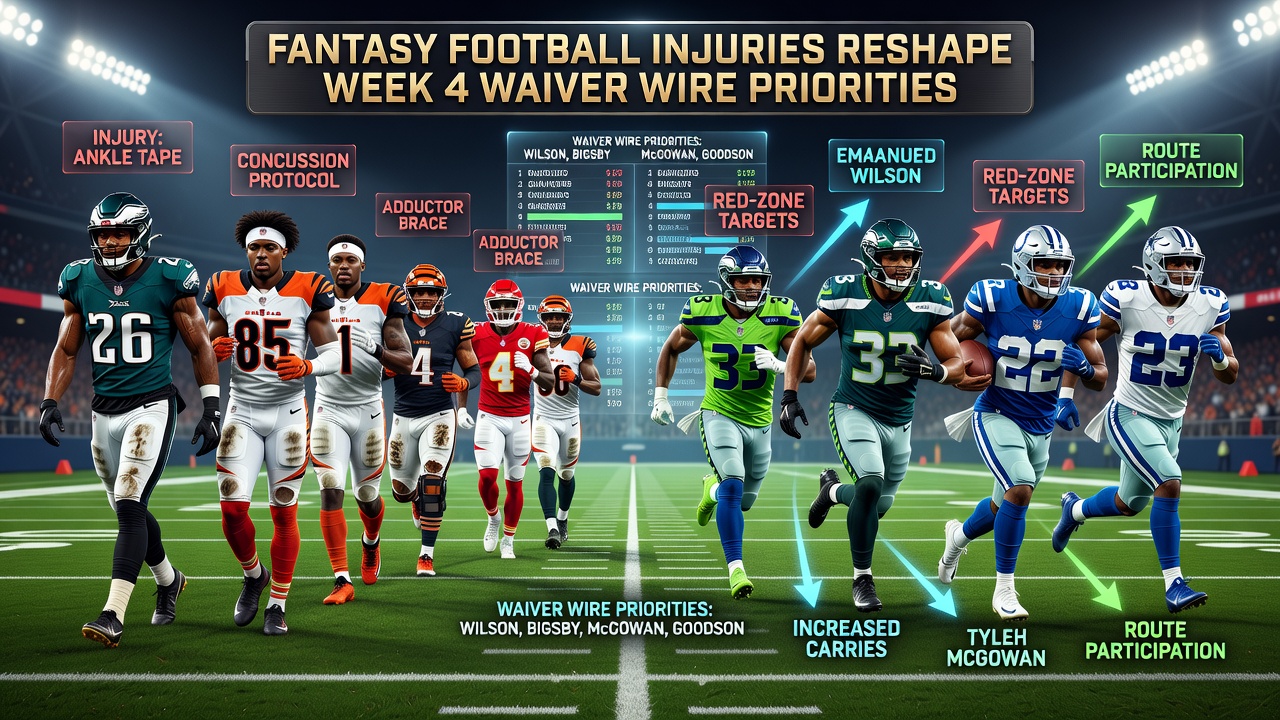
A second straight week of significant injuries to high-profile skill players has forced fantasy managers back onto the waiver wire, this time with Saquon Barkley, Ja'Marr Chase, Tee Higgins, DJ Moore and Rashee Rice all exiting games early. None of the injuries appear to be season-altering, but the ripple effects have created immediate opportunity for backups and complementary pieces across several offenses.
Backfield Uncertainty Drives Early Pickups
Running back remains the position most vulnerable to a single injury wiping out projected value overnight, and this week's news cycle reinforced why handcuff backs carry more weight than their weekly stat lines often suggest. Emanuel Wilson's workload in Seattle, following Jadarian Price's placement on injured reserve, stood out for its scope - carries, targets and red-zone usage all pointed to a back trusted with full-service duties rather than a short-term fill-in. Tank Bigsby's role behind an injured Barkley in Philadelphia carries similar logic: when a lead back's absence stretches beyond a single week, the backup's practice-squad-level name recognition becomes secondary to pure opportunity.
Depth chart math matters here. Seth McGowan's six carries behind Jonathan Taylor's twenty reflect a backfield with almost no shared work, meaning McGowan's fantasy relevance is entirely contingent on Taylor's health rather than his own usage pattern. Tyler Goodson's situation in Dallas follows a familiar script - a projected backup lost to injury, an unproven replacement inheriting unexpected opportunity. These names rarely cost much in free-agent bidding now, which is precisely the point: securing cheap insurance before a starter's injury forces a bidding war is a more disciplined approach than chasing value after the fact.
Receiver Rooms in Flux After Concussions and Soft-Tissue Injuries
Wide receiver situations shifted just as dramatically. Cincinnati's receiving corps lost both Chase, to a concussion that will require clearing protocol, and Higgins, to an adductor injury, opening significant target share for less heralded options. Buffalo's Keon Coleman and Washington's Antonio Williams both posted route-participation numbers that outpaced their final box scores, a gap that often signals a player whose underlying role is stronger than the scoreboard suggests. Target share and route participation are generally more predictive of future performance than a single week's yardage total, since they reflect a coaching staff's trust rather than one favorable matchup.
Kansas City's situation adds a different wrinkle: a rookie who generated training-camp buzz but hadn't converted it into regular-season production may now see expanded opportunity purely because two players ahead of him got hurt. That kind of role change is speculative by nature, and treating it as a confirmed breakout rather than a conditional opportunity is the more responsible read.
What This Means for Roster Management
Fantasy football, like other prediction-based contests built around uncertain outcomes, rewards process over results in the short term. A player's one-week stat line is a poor substitute for the underlying usage metrics - target share, route participation, red-zone touches - that tend to persist or fade more gradually. Treating waiver-wire decisions as calculated probability assessments, rather than reactions to a single box score, is the more sustainable approach across a full season. None of this guarantees outcomes; injuries, coaching decisions and matchup variance will continue to produce surprises no model fully anticipates.