
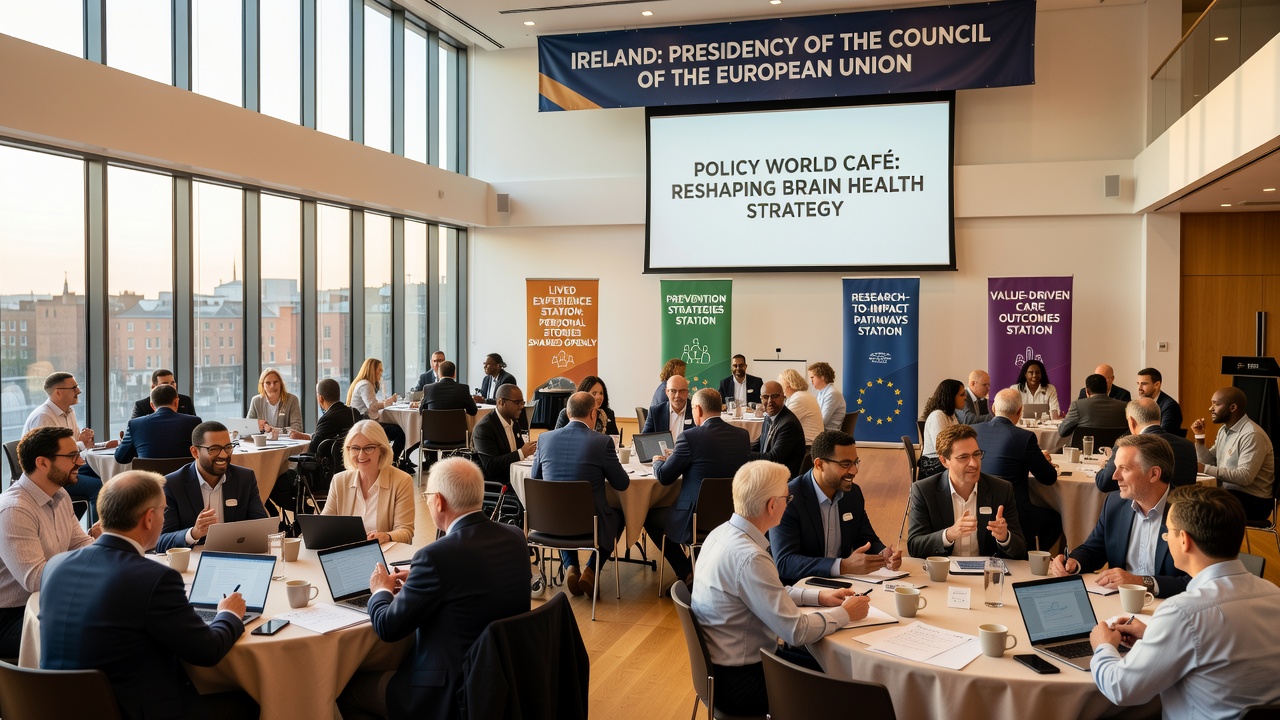
Brain health policy is about to get a format overhaul. Rather than another conference of panels and keynotes, organisers behind A Value-Driven Future for Brain Health & Care are staging an interactive Policy World Café, seating people with lived experience and carers alongside policymakers, clinicians, researchers, funders and industry representatives at the same tables. The event unfolds against the backdrop of Ireland's Presidency of the Council of the European Union, a moment that gives national initiatives a louder voice in shaping EU-wide health priorities.
Why the format matters
Health policy gatherings often separate stakeholders by role: clinicians in one room, patients consulted separately, industry engaged through formal submissions. The World Café model rejects that division. By rotating participants through four facilitated challenges - lived experience, prevention, research-to-impact and value-driven care - the structure forces direct exchange between groups that rarely negotiate priorities face to face. The aim is not another report destined for a shelf, but recommendations drafted collaboratively and carried straight into a closing policy dialogue, where they can be tested against the realities of implementation.
Brain health as a system-wide challenge
Conditions affecting the brain, from neurological disorders to mental health and age-related cognitive decline, place sustained pressure on health systems already managing workforce shortages and budget constraints. Treating brain health as a standalone clinical issue, separate from social care, housing, employment support and research funding, has repeatedly produced fragmented services. A value-driven approach reframes the conversation: instead of asking only what treatments cost, it asks what outcomes matter most to patients and carers, and how systems can be designed around those outcomes rather than around institutional silos.
This reframing has practical consequences. Research funders may need to prioritise projects with clearer pathways to patient impact. Healthcare providers may need new models for coordinating neurology, psychiatry, primary care and social services. Industry representatives, including medical technology and pharmaceutical innovators, face pressure to demonstrate real-world value rather than relying solely on clinical trial data disconnected from everyday care settings.
What the European dimension adds
Hosting the event during Ireland's EU Council Presidency is not incidental. Brain health policy varies significantly across member states, shaped by differing healthcare financing models, research infrastructure and levels of patient advocacy. A forum that produces shared recommendations, rather than country-specific proposals, creates material that can feed into broader European health strategy discussions. For smaller member states, this kind of agenda-setting opportunity during a Presidency term is relatively rare and carries weight precisely because it coincides with heightened EU attention.
- Four structured challenge areas: lived experience, prevention, research-to-impact, value-driven care
- Participants include patients, carers, clinicians, researchers, funders, policymakers and industry
- Outcomes feed directly into a closing policy dialogue rather than a standalone report
- Positioned within Ireland's EU Council Presidency to support cross-European coordination
The test ahead
Participatory formats are easier to stage than to sustain. The genuine test for this initiative lies beyond the room: whether the recommendations generated translate into funding decisions, clinical pathway redesign or legislative attention at national and EU level. Bringing diverse voices together is a necessary first step, not a guarantee of system change. What happens after the closing dialogue, and whether policymakers act on priorities set jointly with patients and carers, will determine whether this café model becomes a template for other health domains or remains a single, well-intentioned event.