
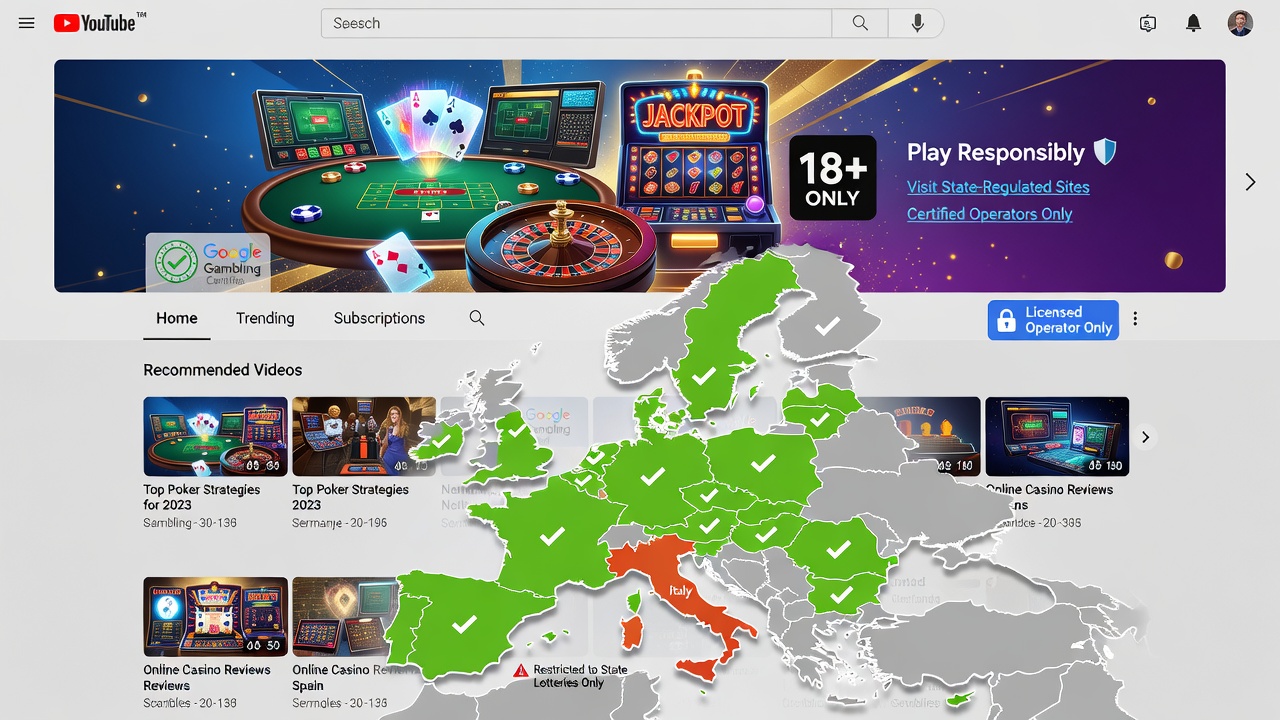
Starting 21 October 2026, certified online gambling operators will be permitted to buy space on the YouTube Masthead, the large promotional banner that greets visitors on the platform's homepage. Until now, that premium slot has been reserved mainly for sports betting companies, with a narrower allowance for daily fantasy sports. The expansion marks a shift in how one of the world's largest video platforms treats gambling advertising, moving beyond sports betting toward a broader category of licensed online gambling products.
A narrower door than it first appears
The change is less sweeping than the headline suggests. Affiliate sites and comparison platforms, the kind that drive traffic to operators without holding a gambling licence themselves, remain excluded. Google's advertising policy classifies these as "online gambling-promoting content," a category treated separately from licensed operators and subject to tighter restriction. Only advertisers holding Google's gambling certification, tied to an actual state or national licence, can bid for Masthead placement. That distinction matters: it keeps the most visible ad format on the platform limited to businesses directly accountable to a gambling regulator, rather than opening it to the wider ecosystem of marketing intermediaries that profit from referring users to betting sites.
Certification, not just payment, decides access
Buying the slot is not simply a matter of budget. Advertisers must hold a valid gambling licence in every market they target and apply separately for certification in each one. Masthead placements also go through an additional review layer that Google describes as stricter than its standard ad vetting. Campaigns must point to landing pages containing responsible gambling information, avoid targeting minors, and stay within the list of countries where gambling advertising is permitted. In Europe, that list currently includes the UK outside Northern Ireland, Germany, the Netherlands, Spain and Sweden. Italy stands apart, restricting eligibility to state-run lotteries with deferred draws, a reflection of how fragmented gambling advertising rules remain across a continent without a single regulatory framework.
Tighter certification arrived first
The Masthead expansion did not happen in isolation. From 14 September 2026, Google introduced stricter certification requirements across its entire gambling and games advertising category, requiring advertisers to demonstrate what the company calls "good policy health" before certification is granted. Positioning the Masthead change roughly five weeks later suggests a deliberate sequencing: raise the compliance bar first, then widen access to the platform's most valuable ad real estate. For operators, this means certification is no longer a one-time formality but an ongoing status that can be reviewed and potentially revoked.
What it signals for the wider market
Platform owners increasingly treat gambling advertising as a compliance problem as much as a revenue opportunity. Tying premium placement to licensing status, country-specific approval, and policy-health checks reflects pressure from regulators and advertising standards bodies across multiple jurisdictions to limit exposure of gambling content to unlicensed markets and vulnerable audiences. For advertisers, the practical effect is a higher administrative burden: separate applications per country, ongoing scrutiny, and landing pages that must carry responsible gambling messaging rather than pure promotional content. For users, the change does not alter the underlying risks associated with gambling products, it simply places that advertising on a platform with stricter oversight than many of the channels where unregulated gambling promotion still circulates.