
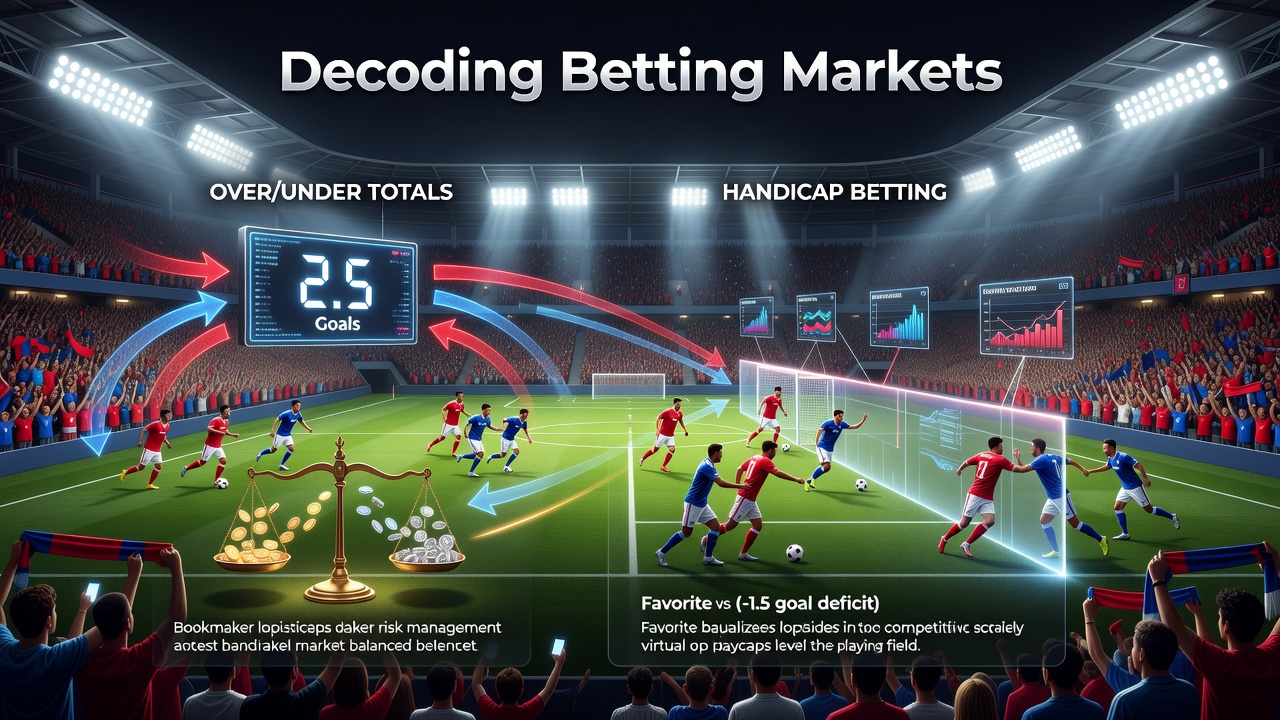
Every sportsbook builds its business on a handful of recurring betting structures, and the three most common - totals, handicaps, and both-teams-to-score markets - account for a large share of wagers placed on football and other major sports. Understanding how these markets are priced, and what they actually measure, matters more than most bettors assume. The mechanics behind each market reveal how bookmakers manage risk, and that knowledge is as useful for spotting poor value as it is for following a match.
How Totals Markets Balance Bookmaker Risk
Over/under betting, or totals, asks a simple question: will the combined scoring in a match land above or below a line set by the operator. That line is not arbitrary. It reflects a bookmaker's model of expected scoring, adjusted continuously as money comes in on either side. A total set at 2.5 goals is designed to split opinion roughly evenly, which is precisely how bookmakers protect their margin regardless of the eventual outcome. For bettors, the appeal is that a totals bet sidesteps the need to pick a winner, focusing instead on tempo and attacking intent from both sides.
Handicaps and the Economics of Uneven Matchups
Handicap betting exists because lopsided fixtures produce unattractive odds on a straight match-winner market. By applying a virtual goal or point deficit to the favorite, bookmakers create a contest that looks statistically closer, which keeps betting volume flowing on both outcomes. A -1.5 handicap on a strong favorite effectively asks whether that team can win by two clear goals, not just edge the game. This mechanism is central to how operators keep odds competitive on fixtures that would otherwise carry minimal betting interest on the underdog side.
Both Teams to Score and the Limits of Pattern-Based Betting
The both-teams-to-score market has grown because it rewards attacking narratives rather than final results, and it can produce winning bets even in a drawn match. Its popularity also illustrates a wider trend in sports betting: markets increasingly isolate specific in-game events rather than the scoreline alone, a shift driven partly by live and in-play betting technology that lets odds shift in real time as a match unfolds. That technical evolution has made betting more granular, but it has not changed the underlying arithmetic - bookmakers still price in a margin, and no combination of statistics, team form, or historical head-to-head data eliminates the uncertainty inherent in sport.
Reading the Market Responsibly
Statistical research, awareness of payout differences between licensed operators, and tools like exportable betting history can help bettors make more informed decisions and recognize their own patterns of behavior. None of this guarantees profit. Betting markets are structured so that the operator retains a mathematical edge over time, and treating any market - totals, handicaps, or both-teams-to-score - as a reliable income source misrepresents how these products work. Bettors who track spending, set limits, and use operator tools designed for responsible gambling are better placed to treat betting as entertainment rather than a financial strategy.
- Totals and handicap lines are set to balance betting volume, not to predict outcomes with certainty
- In-play technology has made markets more detailed but has not reduced the bookmaker's structural advantage
- Licensed operators are required to provide responsible-gambling tools, including deposit limits and activity history