
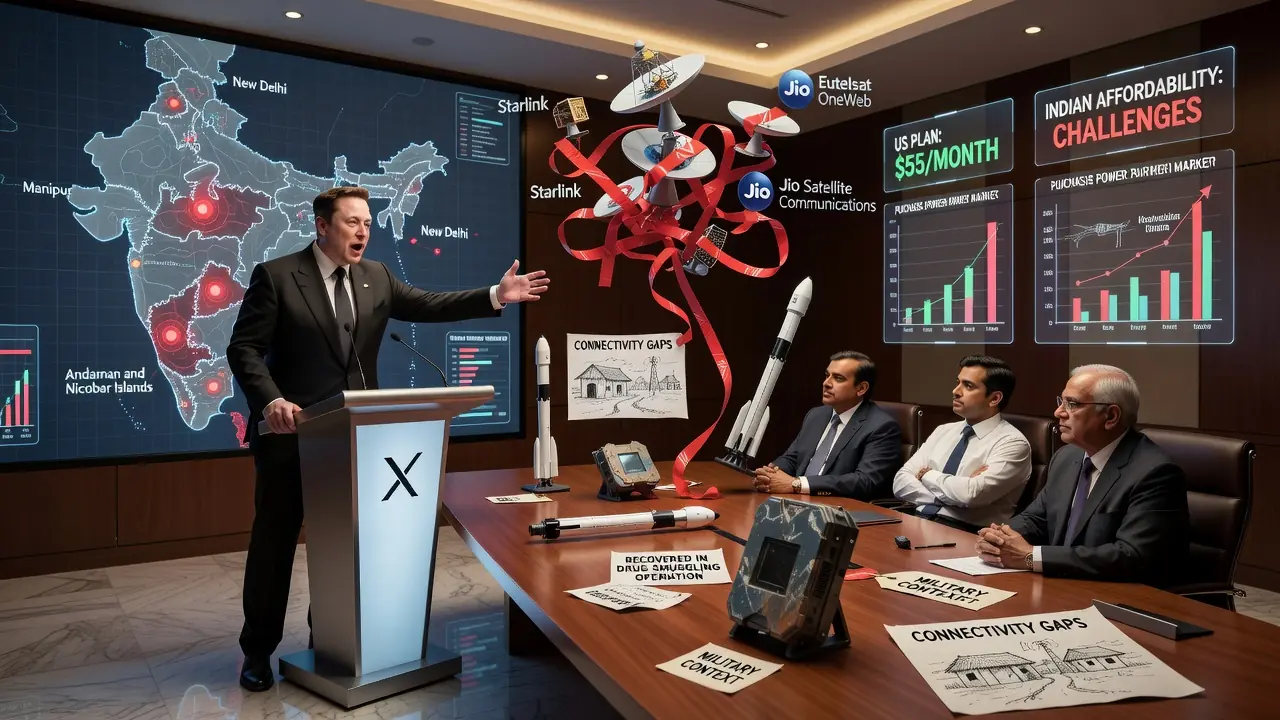
Elon Musk has publicly questioned whether Mukesh Ambani, India's richest businessman, wields more influence over telecom policy than the government itself. The accusation, posted on X, came amid mounting frustration at SpaceX over delays to Starlink's long-awaited launch in India, a market Musk has spent years trying to enter. New Delhi has rejected the claim outright, insisting its satellite spectrum rules apply equally to every applicant.
A Dispute Rooted in Spectrum, Not Just Rhetoric
At the center of the row is a technical but commercially critical process: security clearance and spectrum allocation for satellite broadband operators. India's Ministry of Communications says three companies - Starlink, Eutelsat OneWeb, and Reliance's own Jio Satellite Communications - are at a comparable stage in this process. None has yet received final approval to sell commercial service. That detail undercuts Musk's suggestion that Starlink alone is being singled out, though it does not resolve why approval has taken this long after five years of regulatory engagement.
Spectrum allocation for satellite services is unusually sensitive because it determines how companies compete, and with whom. Unlike traditional mobile spectrum, which is typically auctioned, many countries - India included - have moved toward administrative allocation for satellite bands. Critics of that approach argue it can slow market entry; defenders say it reflects the technical complexity of coordinating orbital slots and frequencies among multiple operators.
Competitors and Partners, Simultaneously
The dispute is complicated by an unusual overlap: Reliance Jio and Bharti Airtel, the two companies Musk has implicitly cast as obstacles, are also Starlink's distribution partners in India. Both signed agreements with SpaceX in March 2025 to sell Starlink hardware and service once regulatory approval arrives, with discussions of shared network infrastructure still open. That arrangement means Jio and Airtel stand to benefit commercially from Starlink's eventual entry, even as they build competing satellite ventures of their own.
Reliance Jio's chairman, Akash Ambani, declined to directly address Musk's allegations when asked at the India Mobile Congress, saying only that the company intends to focus on delivering value to Indian consumers. Airtel's Sunil Bharti Mittal confirmed his company's satellite unit is also still waiting on government sign-off. Neither comment settles the question Musk has raised, but both underline that delay, at least officially, is being experienced industry-wide.
Security Concerns and the Affordability Question
Security vetting has been a recurring sticking point for Starlink in India. Equipment linked to the company was reportedly recovered during a drug-smuggling investigation in the Andaman and Nicobar Islands and during a military operation in Manipur in 2024, incidents Musk said involved hardware that could not have been connected to an active Starlink network in the country. Such episodes feed into broader regulatory caution around satellite internet, a technology that is harder to monitor and restrict geographically than ground-based networks.
There is also an unresolved commercial question: cost. Starlink has not published Indian pricing, but its US residential plans start at roughly $55 a month before equipment costs - a price point that would be out of reach for a large share of Indian households, particularly in the rural areas the service is pitched as serving. Whether satellite internet can meaningfully close India's connectivity gap may depend less on regulatory approval than on whether operators can price it for the market they claim to want to serve.